
Generic AI Chatbots vs. Custom-Trained Chatbots
Why Industrial Buyers Need Clarity, Not Just Conversation
AI chatbots have become a staple across websites in every industry. For many companies, adding a generic chatbot feels like an easy upgrade: it answers simple questions, looks modern, and takes very little time to configure. But for industrial and B2B manufacturers, the difference between a generic AI chatbot and a custom-trained one is far more than a technical nuance. It has a direct impact on the quality of your leads, the friction buyers experience on your site, and the volume of repetitive work that lands on your sales and engineering teams.
Technical buyers don’t behave like casual shoppers. They visit your website because they have a problem to solve and a limited set of constraints they already know—load, voltage, duty cycle, environment, certifications, dimensions, timing. They aren’t looking for friendly small talk. They’re looking for clarity. That’s where the real gap between generic and custom-trained chatbots begins.
Where Generic Chatbots Fall Short
Broad, publicly trained language models power Generic chatbots. They can handle polite conversation, basic FAQs, and high-level definitions. Still, they quickly run out of runway when a buyer asks something that depends on engineering rules or technical documentation.
The more specific the question—whether a particular configuration is compatible, whether a motor is appropriate for an environment, or whether a product meets a specific certification—the more likely a generic chatbot is to guess. And while those guesses may sound confident, they’re often inaccurate. For industrial companies, that isn’t just unhelpful. It can create customer confusion, raise doubts early in the buying journey, and ultimately decrease trust.
Even worse, generic chatbots tend to push buyers into a “contact us” form the moment a question requires depth. That adds friction, delays answers, and increases the number of incomplete or low-quality inquiries your teams have to sift through.
What a Custom-Trained Chatbot Actually Delivers
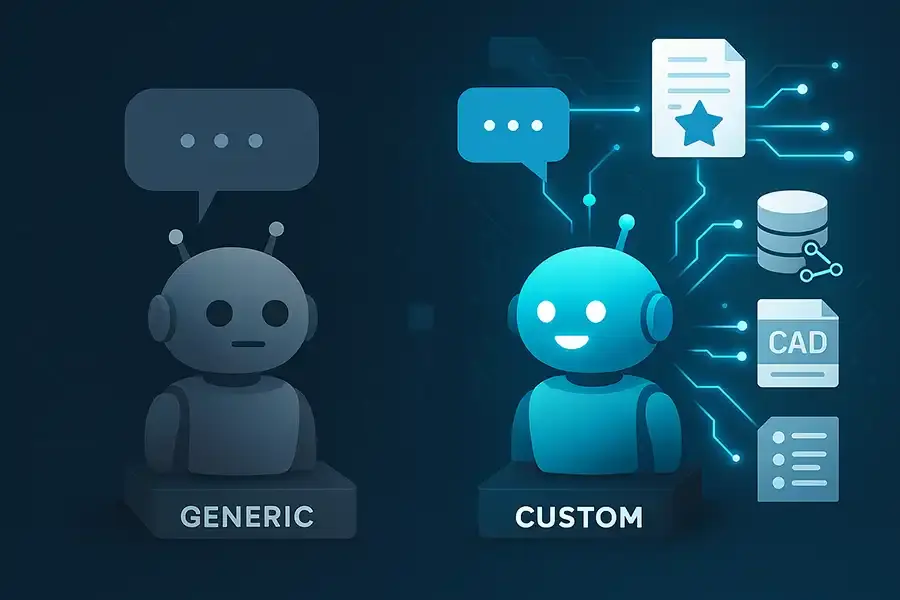
A custom-trained chatbot starts from a completely different premise: it’s designed to help buyers move forward, not just entertain them. Instead of relying on general knowledge, it’s trained on your manuals, spec sheets, ToolDocs™ library, engineering notes, and internal rules. It uses your terminology and understands your product families the way your team does.
The result is a digital assistant that behaves like a scaled version of your best application engineer. It can ask clarifying questions that matter, identify which products fit the buyer’s constraints, and point them directly to the correct specs or documents. It doesn’t guess. It doesn’t wander. And it doesn’t give superficial answers that generate more work for your team.
This shift transforms the chatbot from a novelty into a fundamental tool for digital buyer enablement—one that reduces confusion, keeps buyers moving, and gives them confidence that they’re on the right track.
Reducing Friction and Guiding Buyers Toward the Right Products
Technical buyers rarely come to your website casually browsing for ideas. They arrive mid-process, often trying to match a specific application to the right product. When the information they need isn’t apparent or easily discoverable, they either abandon the process or reach out with incomplete details.
A custom-trained chatbot reduces this friction by acting as a guided path. It fills in missing context, narrows down the options, and helps buyers interpret your catalog through the lens of their own requirements. Instead of forcing them to dig through dozens of pages, it streamlines that experience into a few straightforward steps. This isn’t just about answering questions—it’s about shaping a smoother customer journey that respects the buyer’s time and technical expectations.
Improving Lead Quality and Reducing Repetitive Work
Low-quality inquiries are a quiet tax on industrial sales and engineering teams. When a buyer submits a vague request without enough context, someone internally has to chase down the missing details. That often leads to long back-and-forth email chains, delayed quotes, and time spent deciphering information that should have been gathered upfront.
A custom-trained chatbot helps eliminate that problem. Because it understands your product logic and the constraints that matter, it naturally gathers more complete and accurate information during the conversation. By the time the inquiry reaches your CRM or inbox, it’s already framed with the relevant context—reducing clarification emails and allowing your team to work on higher-value opportunities. In other words, it doesn’t just help buyers. It protects your team’s time.
Fitting Into Real Workflows, Not Living in a Bubble
One of the most significant differences between generic and custom chatbots is how they integrate into your actual systems. Generic chatbots typically operate in isolation: they chat, but they can’t do much beyond the chat window. A custom-trained chatbot can connect to your CRM, pre-fill quote requests, log conversations, or pass application details directly to sales or engineering.
This means the chatbot becomes part of the workflow, not a dead end. Buyers get a more straightforward path forward, and your internal teams receive cleaner, more actionable information.
A Better Digital Buying Experience
At every stage of the customer journey, accuracy and clarity matter for industrial companies. A generic chatbot that provides vague or incorrect information signals that your organization may not have its details in order. A custom-trained chatbot sends the opposite message: that you understand your products deeply, that you respect the buyer’s time, and that you’re willing to help them make the right decision—not just any decision. This is the foundation of trust in B2B manufacturing. And it starts long before the first sales call.
Why Custom AI Is Worth the Investment
For simple consumer websites, a generic chatbot might be enough. But for manufacturers with technical products, complex configurations, or documentation-heavy support needs, it simply isn’t. Your buyers need clarity. Your teams need efficiency. And your digital presence needs to support—not hinder—the early stages of the customer journey.
A custom-trained chatbot delivers precisely that. It reduces repetitive internal work, guides buyers more effectively, increases lead quality, and ultimately improves how your organization supports customers long before they ever talk to a human.
Generic AI gives you a conversation.
Custom AI gives you progress.
And for industrial and B2B companies, that difference is everything. A custom-trained chatbot moves buyers forward, reduces noise for your team, and turns your website into a real digital sales engine.
If your goal is to streamline operations and strengthen the buyer experience, a custom-trained chatbot is one of the highest-leverage moves you can make.