
Winning with Helpful Content: A Guide to Staying Competitive in Google Search
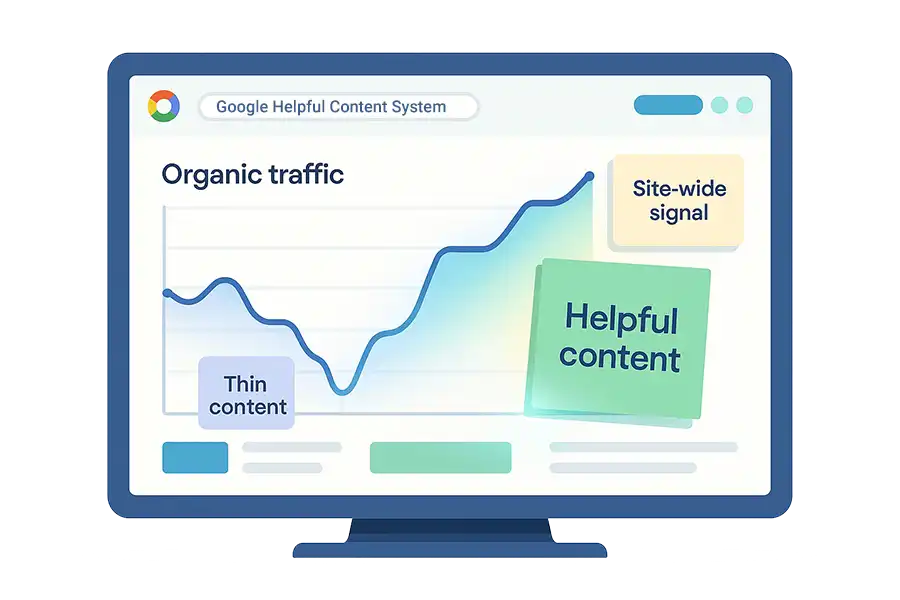
Google’s Helpful Content System (HCS) represents a fundamental shift in how online content is evaluated. By prioritizing 'people-first' content over material created primarily to rank in search results, Google aims to reward authentic expertise and discourage formulaic, low-value pages.
This whitepaper explains how the system works, how it affects digital visibility, and what businesses can do to create sustainable, search-resilient content strategies that build trust, engagement, and long-term growth.
Introduction: The End of “Search-First” Content
For over a decade, SEO strategies often revolved around keyword targeting, link volume, and content output. But as Google’s algorithms have evolved, the emphasis has shifted toward content quality, relevance, and intent satisfaction. The Helpful Content System accelerates this evolution. It rewards websites that prioritize real human value — information that genuinely helps users — and penalizes those that publish content primarily for algorithmic gain.
What is Google’s Helpful Content System?
Overview
Launched in August 2022, Google’s Helpful Content System was designed to identify and reduce the presence of low-quality, unoriginal, or search-engine-oriented content. By 2024, it was fully integrated into Google’s core ranking systems. The HCS uses machine-learning classifiers to assess whether a site provides genuinely helpful content to users, influencing search visibility.
Key Attributes of HCS
- Site-wide impact – Unhelpful content anywhere on a site can affect the ranking potential of all pages.
- User-first focus – Pages are rewarded when they meet real user needs rather than chasing search rankings.
- Ongoing evaluation – The system runs continuously, re-evaluating sites as content is added or improved.
- Integration with E-E-A-T – Experience, Expertise, Authoritativeness, and Trustworthiness remain essential.
Why the Helpful Content System Matters
The Cost of Unhelpful Content
Websites that rely on quantity over quality risk domain-wide ranking declines. Thin articles, repetitive keyword posts, or generic summaries may harm not just those pages but also higher-value ones. Maintaining a smaller number of valuable, relevant, and in-depth pages is more effective than publishing large volumes of superficial content.
The Opportunity for Strategic Growth
This shift rewards organizations that create comprehensive, problem-solving resources; demonstrate real expertise; and maintain a clear domain focus. By aligning content with user needs rather than algorithms, businesses can build stronger visibility and engagement.
How the Helpful Content System Works
The Classification Process
Google uses automated systems to evaluate websites and assign a 'helpfulness' signal. If a large portion of a site’s content provides little user value, the entire site may receive a negative signal — lowering visibility until content is improved or removed.
Google’s Evaluation Criteria
Key questions include:
- Does it demonstrate original insight or expertise?
- Does it fully address the topic and provide comprehensive value?
- Would users feel satisfied after reading it?
- Does it show first-hand experience or deep understanding?
- Would users trust this source?
Strategic Framework for Aligning with HCS
Content Audit & Cleanup
- Inventory all pages – Identify low-value or duplicate content.
- Assess by purpose – Classify as helpful, redundant, outdated, or irrelevant.
- Consolidate or remove – Merge weak pages into comprehensive resources.
- Maintain thematic focus – Keep the site centered on clear, relevant topics.
Creating Helpful Content
- Start with user intent.
- Demonstrate expertise.
- Provide depth and clarity.
- Add unique value.
- Ensure trust and quality.
Challenges and Considerations
- Recovery Takes Time – It may take months for Google to reassess.
- AI-Generated Content – Must add value and undergo human review.
- Domain Focus – Covering unrelated topics dilutes authority.
- User Experience – Readability and layout influence performance.
Action Plan for Organizations
- Perform a full content audit.
- Develop a people-first strategy.
- Establish internal quality standards.
- Train teams and contributors.
- Measure results and iterate.
Final Thoughts
Google’s Helpful Content System underscores a long-term truth: search success now depends on substance, not volume. Sites that prioritize user experience, original insight, and authentic expertise will continue to thrive.
Ask yourself the following
- Does your content demonstrate first-hand experience?
- Does it provide sufficient depth and completeness?
- Would users trust your expertise?
- Does your site have a clear purpose or focus?
- Would a user feel they’ve learned something valuable?